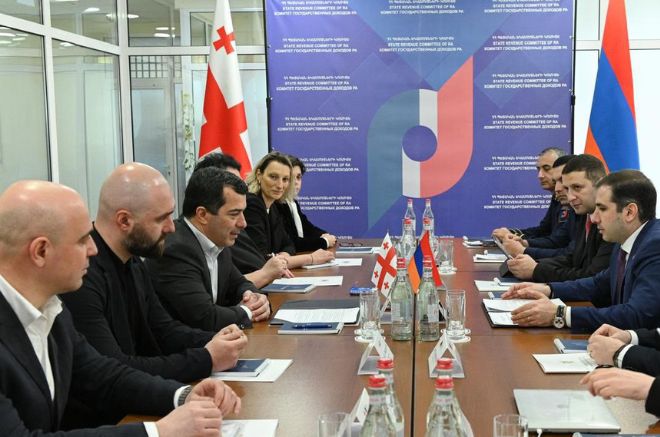

Head of the Revenue Service of the Ministry of Finance, Irakli (Dachi) Beraia, and Head of the Customs Department, Mikheil Chokoshvili, held another working meeting with the Chairman of the State Revenue Committee of the Republic of Armenia, Eduard Hakobyan, to discuss the project of a joint management border checkpoint.
The project envisages the creation of infrastructure in line with modern standards and the simplification of customs control procedures by introducing a joint management system, which will significantly facilitate the smooth movement of passengers, light and heavy vehicles between Georgia and Armenia. The meeting was held at the customs checkpoint “Gogavani” located on the territory of the Republic of Armenia (Guguti BCP on the territory of Georgia), at which the parties discussed the challenges existing between the customs administrations and the possibilities of deepening future bilateral cooperation.
In addition, during the meeting, the parties emphasized the need to introduce the principles of joint management of customs checkpoints, and also positively assessed the process of exchanging preliminary information on cargo and vehicles moving between the borders of the two countries. The joint management of customs checkpoints project is being implemented with the support of the Asian Development Bank (ADB) and is based on the bilateral agreement signed on January 17, 2013 between the Government of Georgia and the Government of the Republic of Armenia “On the Joint Use of Land Customs Checkpoints”.
The entry into force of the Protocol will promote effective cooperation between customs administrations, enforcement of security requirements and legal trade. The meeting, which was held in an expanded format, was attended by the Head of the International Relations Department of the Revenue Service, Archil Darakhvelidze, as well as the Deputy Head of the Customs Department, Irakli Tevdoradze, and other responsible persons. At the end of the meeting, the parties expressed their readiness to continue active cooperation in the future.