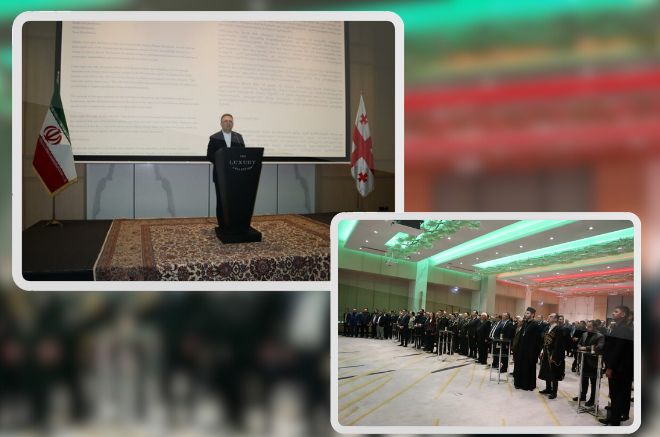

On February 11, an event dedicated to the 47th anniversary of the victory of the Islamic Revolution of Iran was held in Tbilisi.
The event was attended by the Deputy Minister of Foreign Affairs of Georgia, Mr. Lasha Darsalia, ambassadors and heads of diplomatic missions of various countries, military attachés, as well as representatives of culture, economy, media, and other prominent figures, along with members of the Iranian community residing in Georgia.
The guests were hosted by Seyed Ali Mojani together with his spouse and son.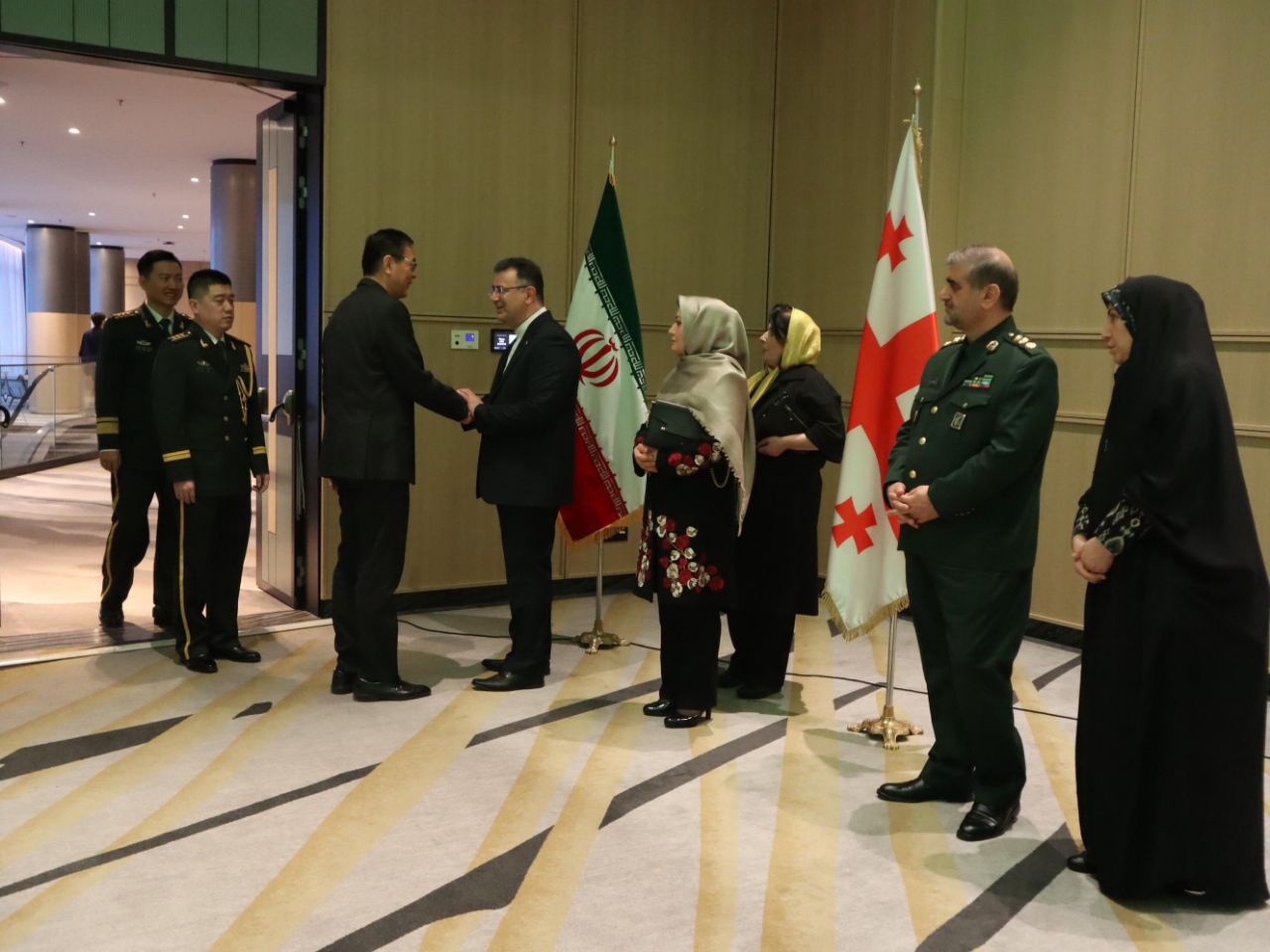
Afterwards, the Ambassador Extraordinary and Plenipotentiary of the Islamic Republic of Iran to Georgia, Mr. Seyed Ali Mojani, delivered a speech:
“In a few minutes, we will mark the 47th anniversary of the great Islamic Revolution and begin the 48th year of this significant event in the history of modern Iran. This event was not merely a change of political power. For the Iranian people, the Islamic Revolution represented a fundamental transformation in the essence of sovereignty, independence, and national dignity.
Forty-eight years ago, the Iranian people rose against a system that saw its survival in subordination to foreign powers and in alignment with the Western bloc in the bipolar world order of that time. The voice of the revolution was expressed in two sentences: ‘The Shah left and the Imam came.’ In two words, the revolution’s call was independence and freedom — replacing monarchy with a republican system.
The main message of the revolution was the rejection of submission, resistance to historical humiliation, and the transfer of power to the people through elections, granting them the right to determine their own destiny — a process that has continued over the past 47 years.
Forty-eight years ago, on this very day, I was an eleven-year-old boy living in central Tehran, just a few hundred meters from the Shah’s palace and the Prime Minister’s office. My memories of that day are associated with a city engulfed in revolutionary fervor, whose people took to the streets to restore dignity, national sovereignty, and democracy.
Dear guests,
For my generation, this is no longer merely a memory — it is a historical responsibility. Today, nearly half a century later, the Islamic Republic of Iran represents an experience in which the Iranian people have sought to simultaneously preserve political independence, social stability, economic development, and an active regional role.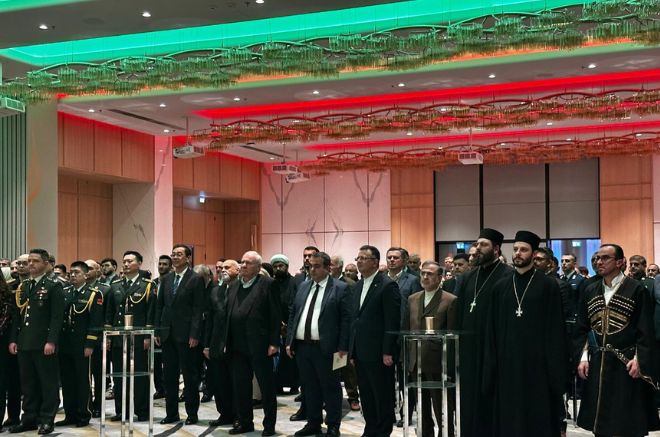
Today’s Iran, situated in one of the world’s most sensitive geopolitical regions, strives to remain active rather than passive amid external pressures, internal developments, and rapid changes in the international order.
Iran’s foreign policy is based on rational engagement, dialogue, and active diplomacy. Its pillar is defensive capability — not founded on weapons of mass destruction, but on national conviction. Thanks to this capability, Iran does not submit to conditions dictated by major powers, does not accept isolation, and always welcomes dialogue as a means of resolving disagreements.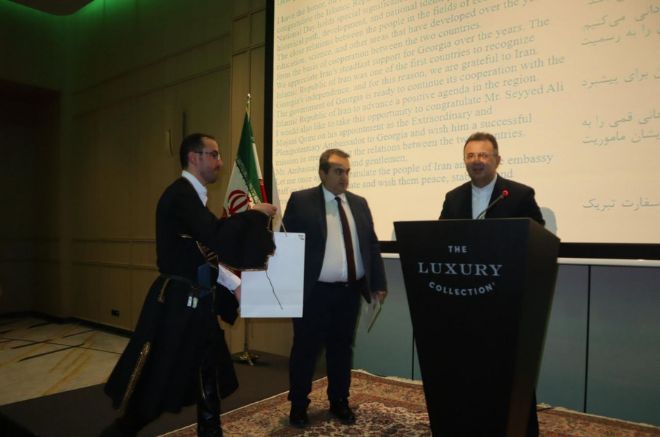
The Islamic Republic of Iran names mutual respect, equal rights, and rejection of unilateral impositions as the only conditions for dialogue.
Iran’s active role in international structures such as the United Nations, the Non-Aligned Movement, the Shanghai Cooperation Organization, BRICS, the Eurasian Union, and other regional mechanisms demonstrates its engagement in shaping a multipolar world order.
Historical experience has taught us that diplomacy without deterrence is ineffective. Defending Iran’s territory, maritime domain, and airspace means defending the nation’s right to life.
For two consecutive centuries, Iran has never initiated a war, yet it has never left any external threat or aggression unanswered.
Despite war, sanctions, political pressure, and widespread restrictions, Iran has achieved significant social progress: expansion of public education, development of healthcare networks, increased life expectancy, and improved access to social services in poor regions — achieved through the collective efforts of the Iranian people under sanctions.
Sanctions even affect essential goods such as medicines. However, today Iran has achieved a high level of self-sufficiency in pharmaceutical and medical equipment production.
Iran has developed its communications networks and digital infrastructure, creating a unique domestic network and entering the era of a knowledge-based economy. Today, Iran is one of Asia’s scientific poles, with thousands of scholars contributing to global scientific production.
The role of women in post-revolutionary Iran is another important social reality. Iranian women are active in academia, healthcare, education, research, and social governance, playing a vital role in national development.
Sanctions primarily harm ordinary citizens — patients, students, workers, and their families. Sanctions are a modern form of collective punishment.
The Islamic Republic of Iran stands today at a historical crossroads — from unipolarity to multipolarity, from hegemony to cooperation, and from sanctions to dialogue.
Iran remains ready for engagement based on respect, equality, and recognition of nations’ right to choose their own path.
It was no coincidence that Iran was the first country at the Paris Peace Conference to call for recognition of the independence of Georgia, Azerbaijan, and Armenia. Iran was also the first country to recognize Georgia’s independence in May 1918.
Georgia, together with Azerbaijan and Armenia, has longstanding historical and civilizational ties with Iran. In 1616, the first group of Georgians arrived in Iran, contributing greatly to trade, architecture, and defense.
Today, a representative of Iranian Georgians serves in the Islamic Consultative Assembly, maintaining language and cultural identity for four centuries.
From Iran’s perspective, Georgia is not merely a distant neighbor but a strategic geopolitical bridge between East and West — a key hub in Eurasian cooperation.”
Reminder: 47 years have passed since the Islamic Revolution of Iran. In 1979, demonstrators supporting the Islamic Republic overthrew U.S.-allied Shah Mohammad Reza Pahlavi.