Thursday, January 29, 2026

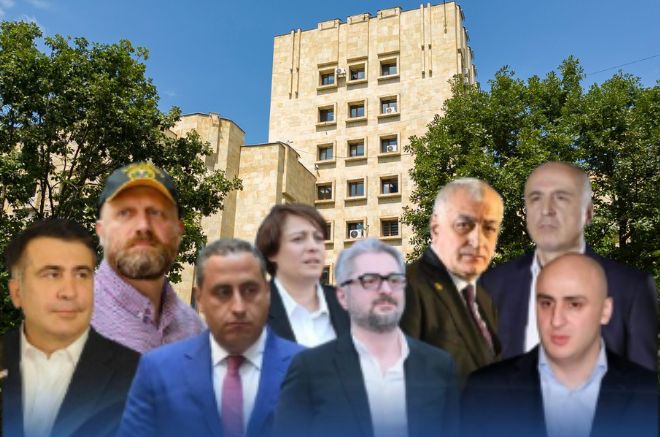
Criminal proceedings initiated against eight opposition figures, including ex-President Saakashvili

“Criminal proceedings have been initiated against Mikheil Saakashvili, Giorgi Vashadze, Nika Gvaramia, Nikanor Melia, Zurab Japaridze, Elene Khoshtaria, Mamuka Khazaradze and Badri Japaridze,” Prosecutor General Giorgi Gvarakidze informed at a briefing held at the Prosecutor’s Office of Georgia.

“Following a joint investigation conducted by the Prosecutor’s Office, the State Security Service and the Ministry of Internal Affairs into crimes against the state, namely sabotage, assistance to a foreign country in hostile activities, financing activities directed against Georgia’s constitutional order and national security foundations, and incitement to violently change Georgia’s constitutional order or overthrow state authority, criminal proceedings have been initiated against Mikheil Saakashvili, Giorgi Vashadze, Nika Gvaramia, Nikanor Melia, Zurab Japaridze, Elene Khoshtaria, Mamuka Khazaradze and Badri Japaridze,” Prosecutor General stated.

According to Giorgi Gvarakidze, the Prosecutor’s Office will apply to the court within the statutory timeframe requesting bail as a preventive measure for Mamuka Khazaradze and Badri Japaridze, and requesting the scheduling of a pre-trial hearing for the other accused.

“Following the outbreak of hostilities in Ukraine, the Georgian government, taking into account national security interests, adopted a policy of not imposing economic sanctions against the aggressor country and maintaining peace within the country to avoid a possible military conflict with the Russian Federation. As a result of this decision, leaders of certain opposition parties operating in Georgia, Elene Khoshtaria, Zurab Girchi Japaridze and Giorgi Vashadze, provided representatives of foreign states, to the detriment of Georgia’s state interests and to create artificial grounds for the imposition of international sanctions, with information regarding the import of petroleum products into Georgia, as well as actual or fabricated information concerning Georgia’s military sphere. They disseminated false information alleging that Georgian airspace was being used to supply Iranian combat drones to the Russian Federation.

Furthermore, Elene Khoshtaria, Zurab Girchi Japaridze and Giorgi Vashadze periodically provided information and documentary materials, including lists of persons employed in public service, to representatives of foreign states for the purpose of imposing sanctions. As a result, various countries imposed sanctions on approximately 300 Georgian citizens in total, including political officials, public servants and individual businessmen.

In October 2024, following the defeat of opposition parties in the parliamentary elections, and under the pretext of alleged electoral fraud, Zurab Girchi Japaridze, Giorgi Vashadze, Elene Khoshtaria, Nika Gvaramia, Nikanor Melia, Mamuka Khazaradze, and Badri Japaridze initiated active measures to radicalise the street protest movement. The named individuals publicly made calls for revolution, the overthrow of the government, the toppling of the authorities, the picketing of state buildings and physical confrontation with law enforcement officers.

Moreover, to overthrow the legitimate government and mobilise, assemble and engage an aggressive mass of citizens in acts of violence, former President of Georgia Mikheil Saakashvili, through the use of his personal social media page and video addresses disseminated through mass media outlets, publicly called upon his supporters to engage in unlawful and violent actions, stating that struggle and aggressive resistance were necessary. In his statements, he also called upon supporters to seize government buildings and ‘overthrow the regime’.

The rallies that began in the vicinity of the parliament building quickly exceeded the boundaries established by law. There were numerous instances of purposeful and organised confrontation with police forces, including the throwing of so-called Molotov cocktails and flammable and incendiary substances at law enforcement officers.
The aforementioned politicians coordinated the actions of the violent groups. Simultaneously, the violent groups operated in mutual agreement and maintained systematic communication with one another through so-called walkie-talkies, which, along with other items, were seized during searches conducted at opposition party offices, including the offices of the United National Movement, Droa and Girchi–More Freedom.

On November 28, 2024, violent confrontation with police officers near the parliament building continued for six days at the leaders’ instigation. As a result, violent groups caused bodily harm to 158 law enforcement personnel, several of whom sustained serious injuries. They set fire to rooms within the parliament building, causing significant damage to the structure, and also set fire to special vehicles belonging to the police. They destroyed state-owned and privately owned immovable and movable property on Rustaveli Avenue.

In parallel with these events, the collection and delivery of funds and material supplies to the violent groups was coordinated with non-governmental organisations and specially created so-called funds, which in turn received funding from international donors, being actively involved alongside the politicians.

Based on evidence obtained during the investigation, Mikheil Saakashvili is charged under Article 317 of the Criminal Code of Georgia, related to incitement to violently change Georgia’s constitutional order or overthrow state authority; Zurab Girchi Japaridze and Giorgi Vashadze are charged under Article 318, Part 1, and Article 319 of the Criminal Code of Georgia, related to sabotage and assistance to a foreign country in hostile activities; Elene Khoshtaria is charged under Article 318, Part 1, Article 319, and Article 321 Prima, Part 1 of the Criminal Code of Georgia, related to sabotage, provision of material resources for the commission of said crime, and assistance to a foreign country in hostile activities; Nika Gvaramia, Nikanor Melia, Mamuka Khazaradze and Badri Japaridze are charged under Article 318, Part 1 of the Criminal Code of Georgia related to sabotage.

The Prosecutor’s Office will apply to the court within the statutory timeframe, requesting bail as a preventive measure for Mamuka Khazaradze and Badri Japaridze, and requesting the scheduling of a pre-trial hearing for the other accused. The investigation continues, and we will periodically provide the public with information regarding its progress and outcomes,” Giorgi Gvarakidze stated.

ქეთევან ნინუაhttp://tiflisnews.ge
საინფორმაციო სააგენტო tiflisnews.ge კონტაქტი- ☎️ 555 100 929

For Georgia: Georgia’s past leadership in Associated Trio never used Moldova’s lagging indicators to justify its progress

“Maia Sandu’s claim that Georgia has returned to Russia’s orbit, presented as fact, diminishes the fierce struggle of the Georgian people,” said Tata Khvedeliani, MP and member of the Gakharia for Georgia party.She criticised the Moldovan president’s statement for undermining both Georgia’s efforts and the European partners’ work to steer Georgia back onto the European path.“I respect President Maia Sandu, but her assertion that Georgia has reverted to Russia’s influence, proclaimed as a certainty, belittles our nation’s hard-fought struggle. It is important to remember that just five or six years ago, when Georgia was leading the trio aspiring to EU membership, we never used Moldova’s lagging indicators as a justification. Our belief remains that Georgia, Moldova, and Ukraine belong in the European Union,” Khvedeliani stated.For context, Sandu told the Parliamentary Assembly of the Council of Europe that Russia has “pulled Georgia back into its orbit by weaponising the fear of war, signalling that the wrong electoral choice would come at the cost of peace.”

Agriculture Minister: Well-functioning irrigation systems are fundamental to agricultural development

The Minister of Agriculture and Environment Protection, Davit Songulashvili, attended the presentation of Georgian Amelioration LLC’s annual report for 2025, which covered the company’s major projects, systemic reforms and achievements.According to the Ministry of Agriculture, the minister thanked company staff for their work throughout 2025 and noted that through joint efforts, the plans set for 2026 can be fully implemented.“Georgian Amelioration LLC is one of our ministry’s most important agencies; we have managed to implement several significant reforms through coordinated work. If we want agricultural development, we must understand that one of its fundamental pillars is well-functioning and efficient irrigation systems. This has necessitated the transformation of the amelioration service and the beginning of a new stage of development. Once again, I confirm our complete readiness to provide maximum support both at the legislative level and through the involvement of central government and other cabinet members, so that the needs of our country are fully met through budget allocation and practical steps,” stated Davit Songulashvili.In 2025, Georgian Amelioration took significant steps towards improving the efficiency of irrigation and drainage infrastructure, enhancing services and managing water resources rationally. Major technical and administrative changes were implemented, rehabilitation and cleaning works were carried out on strategic canals and structures, ensuring a stable water supply to thousands of hectares of land. In parallel, the technical base was modernised, and regional operations were strengthened, positively impacting both agriculture and local employment.During the presentation, the company’s Director General, Gigla Tamazashvili, highlighted the reorganisation that began in March 2025, which resulted in the strengthening of the inspection service, the creation of an information and training centre, and the development of an interactive map; after a 14-year pause, the State Commission for the Regulation of Energy and Water Supply (GNERC) established new irrigation tariffs; a new company logo and brand book were created; the reforms improved internal coordination and operational management, increased revenue collection rates, and achieved record growth in contracted agricultural land – from 60,440 hectares to 74,000 hectares.For 2026, the company has planned major infrastructure projects, including the rehabilitation of irrigation and drainage systems, the construction and modernisation of reservoirs, the implementation of a climate-smart irrigation programme, as well as the introduction of billing and SCADA (supervisory control and data acquisition) monitoring systems. Plans include establishing regional offices and modern, customer-oriented service centres, according to information released by the Ministry of Agriculture.

Parliament Speaker: Maia Sandu supports abolishing her own state; anti-Georgian rhetoric calls for response

“For some reason, Maia Sandu thinks she has some moral, political or ideological superiority to speak to the Georgian people in this tone,” stated the Speaker of Parliament, Shalva Papuashvili.According to him, hearing anti-Georgian rhetoric from the Moldovan President is outrageous.“First and foremost, let me remind you that Maia Sandu is the person who supported the process of overthrowing the government on October 4. When the presidential palace was under violent assault, at that very moment, she publicly supported the group participating in the overthrow of the government. This demonstrates what values this person stands for.It is also highly doubtful that Maia Sandu does this on her own initiative. Once a year, she remembers us and, for some reason, perceives herself as having the moral, political, or ideological superiority to speak to the Georgian people in this manner.When we hear such anti-Georgian rhetoric from Moldova’s President, it is utterly outrageous, and it requires a response. We probably should have had a clear response at the time, beyond statements, when Moldova’s President openly supported the groups participating in the overthrow of the government.Maia Sandu is a person who supports the abolition of her own state. Therefore, I don’t think we have anything to discuss regarding state values. Allow me to remind you of her motivation: her justification was that Moldova is a small state, and a small state cannot survive on its own; therefore, it must join a larger state, rather than acknowledging any cultural or national connection between the Moldovan and Romanian peoples. When a head of state says she considers her country so insignificant that it must be abolished to survive, it is a fact that in terms of values, we are in different orbits,” Papuashvili stated.For reference, Moldova’s President, Maia Sandu, stated during her address to the Parliamentary Assembly of the Council of Europe that “Russia pulled Georgia back into its orbit by weaponising the fear of war, signalling that the wrong electoral choice would come at the cost of peace.”

APCRG Head: Opportunities for price reductions remain through cooperation; medicine pricing reform ongoing

Irakli Margvelashvili, head of the Association of Pharmaceutical Company Representatives in Georgia (APCRG), asserts that opportunities for price reductions always exist through continued cooperation.As Margvelashvili told journalists before the start of a meeting on prices at the Government Administration, the discussion concerns fair prices that should be in place. According to him, the process of regulating pricing in Georgia has been underway for several years.“The discussion is probably about improving the process, refining the methodology and extending it to subsequent groups of medicines. This is precisely where we see the potential,” Irakli Margvelashvili noted.According to Irakli Margvelashvili, approximately 7,000 medicines in Georgia are already on the reference pricing list, which means their prices are regulated through an external reference system.“It is probably expedient at the first stage to discuss prescription medicines and medicines used to treat chronic diseases. The cost of medicine is crucial; it is essential to focus on developing state programmes that ensure the delivery of medicines to patients. Equally important is establishing fair pricing, one that the state should cover and that individuals must pay out of pocket.There are no categories of cheap or expensive; instead, there is a fair price that should align with international standards, considering factors such as geographical location, supply routes, and other relevant aspects. This is precisely why meetings are held: to establish the price that will be fair, specifically for Georgia.The price of medicine in a pharmacy depends largely on how the system is structured. For instance, in European countries, medicine prices may be high or low, but what truly matters is how they are reimbursed by insurance and the state. Ultimately, what matters most to each of us is the amount we personally pay for medicine. What is crucial is the actual expenditure of each citizen on these medicines. Our membership consists of 21 companies. We have achieved significant price reductions over the past three years,” Irakli Margvelashvili stated.

Landslide leaves Sicilian town teetering on cliff edge

NISCEMI, Italy, Jan 27 (Reuters) - Homes in the Sicilian town of Niscemi have been left teetering on the edge of a cliff after a landslide that was triggered by a storm, Italy's civil protection chief said on Tuesday. Niscemi, a town of about 25,000 in south-central Sicily, sits on a plateau that authorities say is gradually collapsing toward the plain below. More than 1,500 people have had to be evacuated. Make sense of the latest ESG trends affecting companies and governments with the Reuters Sustainable Switch newsletter. Sign up here.Buildings were overhanging the edge after large sections of the slope gave way. A car was left with its front end poking into the chasm."Let's be clear: there are homes on the edge of the landslide that are uninhabitable," the civil protection head Fabio Ciciliano told reporters in Niscemi, saying residents from the affected areas would be permanently relocated. "Once the water has drained away and the moving section has stopped or slowed, a more accurate assessment will be made ... The landslide is still active," he added. On Monday, the Italian government of Prime Minister Giorgia Meloni declared a state of emergency for Sicily, Sardinia and Calabria, the three southern regions battered by the violent storm last week.Item 1 of 3 A drone picture shows houses perched along the edge of a cliff after a landslide in Niscemi, Sicily, Italy, January 27, 2026. REUTERS/Danilo ArnoneA drone picture shows houses perched along the edge of a cliff after a landslide in Niscemi, Sicily, Italy, January 27, 2026. REUTERS/Danilo Arnone Purchase Licensing Rights, opens new tabExtreme weather events have become more frequent in Italy in recent years. Floods have devastated cities across the country, killing dozens of people and amplifying risks of landslides and floods also in historically less exposed areas.The administration set aside 100 million euros ($119 million) for the initial needs of the areas worst hit by the recent storm. But local authorities estimate damage at over 1 billion euros after powerful winds and waves pushed the sea inland overwhelming coastal defences, destroying homes and businesses. In Niscemi, the sudden evacuations have fuelled anxiety and anger among residents, some of whom say earlier landslides went unaddressed. "I have been told that I have to leave, even though I don’t have anything (collapse) in the house or underneath," Francesco Zarba said. "We had the first landslide 30 years ago, and no one ever did anything."source of information:https://www.reuters.com/sustainability/climate-energy/landslide-leaves-sicilian-town-teetering

Latest News