
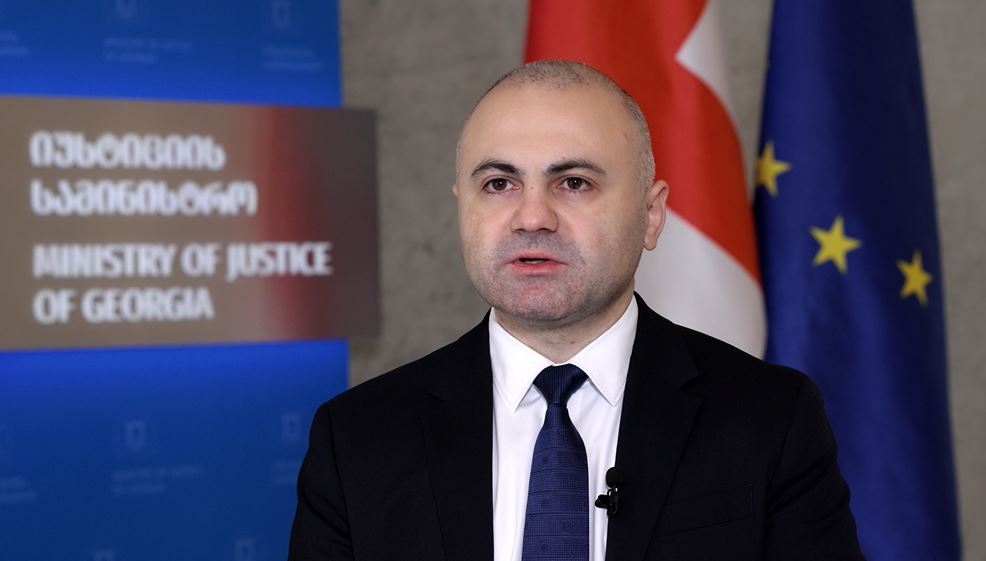

“The Government has until May this year to submit its initial position to the Strasbourg Court regarding the factual circumstances, admissibility of complaints, and substantive aspects concerning the October 2024 parliamentary elections,” Deputy Justice Minister of Georgia Beka Dzamashvili has announced.
According to him, complaints from eleven individuals and one non-governmental organisation concerning the October 2024 parliamentary elections have been submitted to the Strasbourg Court.
“It should be noted that some of these complaints were submitted at the end of 2024 and others at the beginning of 2025; however, the European Court is examining them through standard procedure without expediting. Accordingly, the Government has until May this year to present its position. The complainants will then have the opportunity to respond, and Georgia’s Government will present the final position. It is also significant that the complaints themselves establish that some of them, back at the end of 2024, requested that the European Court apply interim measures in the form of suspending the election results, which the European Court did not grant.
With regard to the substance of the complaints, some complainants allege that there was a breach of ballot secrecy, while others, residing abroad, believe their rights were infringed because additional polling stations were not established outside the country’s borders.
Regarding the ECHR’s questions, the Court is interested in the extent of any existing evidence concerning violations of ballot secrecy. It also wishes to understand how extensively this right might be compromised, particularly in cases where the state has not established enough polling stations outside the country’s borders.
The European Court also raises the question of the extent to which GYLA, a non-governmental organisation acting as an observer, can be a complainant in this case.
It is of great importance for the European Court to examine this matter, as it will provide an authoritative legal assessment on the issue. We believe that a definitive conclusion should finally be reached to put an end to all speculation surrounding the 2024 elections.
Until then, all stakeholders, both domestic and international, must respect the European Court, await its procedures, and refrain from making any speculative comments on the subject. This decision is also significant in that it will set a precedent; specifically, the European Court’s ruling concerning Georgia, particularly on electronic voting and the number of polling stations abroad, will serve as a precedent for other European states as well,” stated Beka Dzamashvili.
According to the Deputy Minister, it is established that some of them, back at the end of 2024, requested that the European Court apply interim measures in the form of suspending the election results, which the European Court did not grant.
Moreover, according to information from Georgia’s Ministry of Justice, the Strasbourg Court is posing specific questions to the parties:
“1) Do the complainants have any evidence with which to prove that their ballot secrecy was violated; 2) To what extent is it possible that the right to free elections (Article 3 of Protocol No. 1) was violated because more polling stations were not opened abroad; 3) Can GYLA, as an observer, argue about possible violations of the right to free elections?”
The Georgian Young Lawyers’ Association (GYLA) stated today that the Strasbourg Court commenced examination of complaints submitted concerning the 2024 parliamentary elections.